Showing posts with label Richard. Show all posts

Tuesday, March 17, 2009

Vaudeville - Time To Talk. Part 1.


The show returns to the stage after having a night off. Everybody has been telling me that the show has been getting better and better, so I'm excited to see it again after missing a couple of nights.

The first Tuesday in a season at the Malthouse is “Time To Talk” night. Peter Clarke hosts the session, which is a forum where audiences have the opportunity to speak to the creatives and performers about the show. Thanks must go to Peter for facilitating the discussion; he is so informed about theatre and is such an accomplished communicator that I couldn't imagine anybody doing a better job.

I made some notes on the forum. Some of what came up we have covered already in the blog, but there was plenty of new stuff too. Of course, it's also interesting to hear what questions people have about the show. Because of the sheer volume I’ve decided to break it up into 2 separate posts.

Peter opened up the forum by asking Chris and Lally about the relationship between research and theatre, and what the genesis of the piece was.

As we know, nearly 4 years ago Chris discovered a book called “Act as Known” by Valentyne Napier in a Brunswick Street book shop. Napier’s parents spent their lives in vaudeville and were famous for their Spider and Butterfly act. Their lives, and the lives of the other performers and the theatres they worked in are the subject of Napier’s book. This book sparked Chris’s interest in working on a show inspired by Australian vaudeville.

Chris and Lally then successfully applied for a residency at the State Library of Victoria to research Australian vaudeville acts. The pair were especially interested in the forgotten people of history; the ones who are not celebrated by history. Rather, the ones that fell through the cracks, and can only be found in small newspaper articles or pieces of ephemera.

Lally's research was more hap-hazard. She would get stuck musing on a particular article, or find herself reading unrelated advertisements. Chris was more methodical and would drive Lally towards articles and information of note.

One particular theme that came up a lot in their research was how often drownings in the Yarra River would be reported on. The river gained a monstrous persona that would rise up to absorb people into itself; drowning them and burying them in mud.

They also mentioned the influence on the work of entertainment entrepreneur Harry Rickards. (There's a link to his bio on the right.)

One of the audience members asked how the actors dealt with the form and style of the piece, given the different styles of the two acts, and the quite specific requirements of vaudeville?

Matt responded by saying that for him it was quite a natural extension from the direct style of presentation that is used in circus.

Christen said that her greatest concern was in the ventriloquism. It's a highly skilled art form in its own right, and although she was continually told that her character was not a good ventriloquist, performing something badly is not necessarily any easier than performing it well. She went on to say that the two acts provide two distinct challenges. The first act requires immersion in the world of vaudeville. The second act requires what Christen called 'capital M Magic'- big emotion, big moments, bold commitment. Addressing these two different approaches in a single show was a big challenge.

Julia talked about understanding the world of the piece, and how it only crystalised for her once she was playing on the set and working in the costumes. These things were crucial in her development of the character.

Alex responded that he saw it quite simply; he tries to do what the director tells him to do.

Jim said he had a couple of ways in. One of which was the voice of John Meillon's character in The Picture Show Man.

The discussion moved on to design. Jonathon was roundly applauded for his work on the costume and set. As was Richard, for his lighting.

Richard revealed the way he had approached the contrast between the two acts in respect of the lighting design. He said that the first act was defined to a large degree by the footlights, a traditional feature of the old theatres. Footlights tend to flatten a space, and this became the primary feature of the design. But, in the second act he was working to make the performers and the space more three dimensional. He also wanted to give the performers the impression of being ghosts, that would at times feel as though they were floating in the space.

More from the Time To Talk tomorrow! I've moved the Countdown clock to when the show ends, so if you've not seen it yet get down to the Malthouse. It will close faster than you think!

Tuesday, February 24, 2009

Vaudeville Rehearsal Day 17 - See how the whole play runs...

The day starts with magic. Obviously I'm not at liberty to divulge any of that, so I headed down and spoke to Richard Vabre, the lighting designer. We were emailed a question in the week from Ian. It reads;

"Given that lighting technologies were far less advanced in Vaudeville days than they are today, how is the time period affecting the lighting design, if at all?"

This is Richard's reply.


When I get back to the rehearsal room. Jim and Chris work on some non-speaking bits. It's a scene focused on busy-ness. Chris thumps the floor at a fast pace to emphasize the pace at which Jim needs to move. He's banging the floor so hard that I could hear him down in the foyer. There was a slight jump in the rhythm which I now realise was Chris changing hands.

At the same time Stephen takes Christen to another room to do what Christen calls “remedial comedy classes.” They've both got a great ear for comedy, and the detailing they come back with is good stuff.

Chris moves onto some of the more important scenes to the central relationships. It will be interesting over the next few days to what Chris spends the majority of his time with. Whether it reveals what scenes the director sees as at the heart of the piece?

Richard, Jethro and Jonathon are all working extremely hard at the moment. The design element on this show across all levels is tremendously well developed, and generates a huge volume of work for everybody on the design team. That reminds me that I've got to get down to Wardrobe again to see how Amanda and Kate are getting on with the costumes.

The company prepares for a run in the afternoon. They are running the entire show. This is the first serious run of the whole show beginning to end. There's a little tension in the air, but nothing like last week.

When it's over it feels to me like a 'whole' for the first time. But what does Chris say?

He thinks it's taken a big step on from Friday, especially Act Two. Act One was a little bitsy, but to be expected since they've been concentrating so much on Act Two. He talks about the action between scenes in Act One, and the upstage action. Transitions are a big job at this stage of just about any process.

He thinks that Act Two is starting to work well. He says that the scenes they haven't touched on for a time that are the weakest, which is both predicable and reassuring. He also talks about how Act Two works from state to state. Again, a transition and rhythmic thing.

There's a bit of discussion about the set. Now that it's being built in the theatre there are some realisations occurring for everybody about how the set is going to work. They talk about some of the potentials they may be able to work with once they get in the space.

It's an issue in making professional theatre that is very hard to solve; how the actors can fully inhabit their world when they often don't get to work within it properly until production week. As we saw in the video last week, the rehearsal room is well kitted out with a genuinely impressive approximation of the set. Even so, it still doesn't feel the same as the theatre, or sound like it. And there are lots of minute physical details of the environment that will be different. Often it is these details that fire the actors' imaginations, and define the world. The way the performers engage with the set is the difference between it being perceived as a 'world' or a 'backdrop.'

Maryanne watched the run again this afternoon and took some more notes. My discussion with her the other day was more wide ranging than the couple of minutes of video. What a dramaturge does can be a bit of a mysterious art at times. But, it's worth relating some more of the conversation because it's interesting relative to how work is developed by theatre companies more generally.

Maryanne mentioned that dramaturgy is often thought of as primarily script work. She sees the role quite differently. She is very much focused on the whole; the physical images, the sound, the juxtaposition of elements, the actors' interpretations of moments, the character arcs, and really everything that comprises the production.

She talks about feeling the energy of the room, understanding where the actors are at in the process, how certain people watching the rehearsal might influence the particular run. Also, the need to feel what the director and writer are going for, and contribute within that frame. She needs to provide a fresh eye and an objective eye, but place herself in the frame of what the creatives are working towards, (which is possibly not at all an objective or readily understandable place.)

Time, time, time. Yes, the run confirmed that development is tracking well. But the countdown clock up top of this blog ticks on. Is there enough rehearsal time before the play opens to audiences? Just three more days in the rehearsal room, then we're in the theatre. That's when the pressure will really start to rise!

Tomorrow, something a little different - a second-by-second run down of an hour in the Vaudeville rehearsal room. Don't miss it!!

Darren word for the day – charred
Chris one word for the day – marathon

Wednesday, February 4, 2009

Rehearsal Period Day 3 - One in, All in.


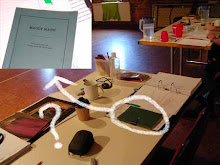
Yesterday’s photograph; you’re probably wondering what that was about. Well, there’s a book that has been published for the show. It’s called “Muddy Magic” and I’ve been told there’s only 4 copies in the world. What’s more, access is extremely limited. More on that when nobody’s around and I can sneak a peak at it.

Days begin and end with singing; first thing and last thing. I asked Chris to comment on that;

“Singing around the piano is a great way to set the atmosphere for the day, and the perfect tool for building the ensemble, and helping them to get into each other’s rhythms.” (despite the quotation marks, that’s not actually a direct quote. You can ask New Weekly how that goes.)

Early in the day we were treated to one of Matt’s signature circus acts. We were talking about circus yesterday in the script discussion. It was mentioned that circus acts are so appealing because we see the performers doing things that shouldn’t be possible. It’s an expression of optimism and inspiration because it cracks the limitations we think constrict our lives. Matt was performing the act so the designers could judge whether it would fit in the confines of the set. While he was performing it there were jokes and commentary until a very specific moment. At that moment the act tipped over into what everybody felt was dangerous territory, and as one, everybody in the room fell silent. The power to spellbind a crowd; now that’s power for an actor.

The morning carried on with the script from where we left off yesterday. We moved on to the first big group scene. So many different things to work on all at once in this scene! The first big group scene is an establishing scene in many ways; spatially, in narrative, character construction, character relationships, tone, atmosphere, rhythm...the list is endless.

The process is one of ‘feeling’- Chris, Mark on piano, and the cast ‘feel’ their way into the world of the play. Everybody works through the scene making tentative offers of all kinds. There are subtle exchanges between everybody in the room. Chris encourages the performers to explore the ‘stuff’ of their characters when they aren’t the focus of the scene. He carefully insists that everything is available to change. It’s not a process of decision making. The group makes a series of offers that combined begin to define a sense of the world, while at the same time they feel their way through what the script is guiding them to do.

You get the sense that the greatest progress being made is perhaps not to the scene itself. The progress is in the slow definition of their world.

The first part of the afternoon is dedicated to working on Maude & Doris, the character played by Christen, and her ventriloquist’s dummy. Christen is not an experienced ventriloquist, and the process of learning to work with the dummy is wonderful and fascinating. Seems like something that could serve as valuable actor training in the same way that mask work is a part of many training courses. She is creating two characters who are the same person, using different tools for each. It seemed to me as I was watching that the kind of technical, practical questions that are necessarily asked of the dummy could quite often elucidate things for a 'human' character. I’ll try to talk with Christen about this when an opportunity presents itself.

I snuck a couple of questions to Richard, the lighting designer, as we watched the rehearsal. I asked him what he was most looking for at this stage of the process. His response was,

“Physical blocking, tone of the piece, feel of the world…”

And what does he see as his biggest questions to answer at this stage? He had two responses;

“I need to know more information about the set,” was his response. The shape and intent of what will be built is clear from the design presentation, but some set elements have a lot of detail that won’t be totally understood until it’s been built. This is an ongoing issue for professional theatre-makers. How do the artists develop a relationship with their physical world if they can’t interact with it?

And,

“How am I going to tackle the third act?” Yeah, the imaginative demands are massive for the third act. This is one of the big design/direction questions of the play.

Finally, I asked Richard how much of his work is technical/practical and how much is interpretative/creative. He said it is about 50/50.

Darren’s word for the morning – blocking
Darren’s word for the afternoon - cut
Richard’s word for the morning – entertaining
Stephen’s word for the morning – spread
Chris's word for the day - door