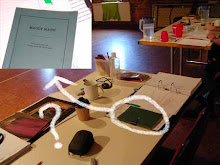
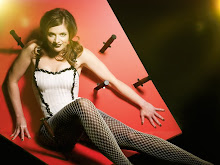
The day starts with magic. Obviously I'm not at liberty to divulge any of that, so I headed down and spoke to Richard Vabre, the lighting designer. We were emailed a question in the week from Ian. It reads;
"Given that lighting technologies were far less advanced in Vaudeville days than they are today, how is the time period affecting the lighting design, if at all?"
This is Richard's reply.
When I get back to the rehearsal room. Jim and Chris work on some non-speaking bits. It's a scene focused on busy-ness. Chris thumps the floor at a fast pace to emphasize the pace at which Jim needs to move. He's banging the floor so hard that I could hear him down in the foyer. There was a slight jump in the rhythm which I now realise was Chris changing hands.
At the same time Stephen takes Christen to another room to do what Christen calls “remedial comedy classes.” They've both got a great ear for comedy, and the detailing they come back with is good stuff.
Chris moves onto some of the more important scenes to the central relationships. It will be interesting over the next few days to what Chris spends the majority of his time with. Whether it reveals what scenes the director sees as at the heart of the piece?
Richard, Jethro and Jonathon are all working extremely hard at the moment. The design element on this show across all levels is tremendously well developed, and generates a huge volume of work for everybody on the design team. That reminds me that I've got to get down to Wardrobe again to see how Amanda and Kate are getting on with the costumes.
The company prepares for a run in the afternoon. They are running the entire show. This is the first serious run of the whole show beginning to end. There's a little tension in the air, but nothing like last week.
When it's over it feels to me like a 'whole' for the first time. But what does Chris say?
He thinks it's taken a big step on from Friday, especially Act Two. Act One was a little bitsy, but to be expected since they've been concentrating so much on Act Two. He talks about the action between scenes in Act One, and the upstage action. Transitions are a big job at this stage of just about any process.
He thinks that Act Two is starting to work well. He says that the scenes they haven't touched on for a time that are the weakest, which is both predicable and reassuring. He also talks about how Act Two works from state to state. Again, a transition and rhythmic thing.
There's a bit of discussion about the set. Now that it's being built in the theatre there are some realisations occurring for everybody about how the set is going to work. They talk about some of the potentials they may be able to work with once they get in the space.
It's an issue in making professional theatre that is very hard to solve; how the actors can fully inhabit their world when they often don't get to work within it properly until production week. As we saw in the video last week, the rehearsal room is well kitted out with a genuinely impressive approximation of the set. Even so, it still doesn't feel the same as the theatre, or sound like it. And there are lots of minute physical details of the environment that will be different. Often it is these details that fire the actors' imaginations, and define the world. The way the performers engage with the set is the difference between it being perceived as a 'world' or a 'backdrop.'
Maryanne watched the run again this afternoon and took some more notes. My discussion with her the other day was more wide ranging than the couple of minutes of video. What a dramaturge does can be a bit of a mysterious art at times. But, it's worth relating some more of the conversation because it's interesting relative to how work is developed by theatre companies more generally.
Maryanne mentioned that dramaturgy is often thought of as primarily script work. She sees the role quite differently. She is very much focused on the whole; the physical images, the sound, the juxtaposition of elements, the actors' interpretations of moments, the character arcs, and really everything that comprises the production.
She talks about feeling the energy of the room, understanding where the actors are at in the process, how certain people watching the rehearsal might influence the particular run. Also, the need to feel what the director and writer are going for, and contribute within that frame. She needs to provide a fresh eye and an objective eye, but place herself in the frame of what the creatives are working towards, (which is possibly not at all an objective or readily understandable place.)
Time, time, time. Yes, the run confirmed that development is tracking well. But the countdown clock up top of this blog ticks on. Is there enough rehearsal time before the play opens to audiences? Just three more days in the rehearsal room, then we're in the theatre. That's when the pressure will really start to rise!
Tomorrow, something a little different - a second-by-second run down of an hour in the Vaudeville rehearsal room. Don't miss it!!
Darren word for the day – charred
Chris one word for the day – marathon
Tuesday, February 24, 2009

Monday, February 23, 2009
Vaudeville Day 16 - The Set has left the workshop
The first day of the final week. And the set has left the worshop and is being built in the theatre. I'll try to sneak in and get a shot if I'm allowed:-

There's been some activity over the weekend, but not a lot of activity; a really good sign. Chris and Lally have decided to make a few cuts here and there, but the broad feeling is that the work that needs doing is predominantly on the scenes, not on the script.
It's an interesting balance for new scripts. Established scripts and 'classic' scripts have their own validation. There is an implied onus on the company to make the script work. When it is accepted that the writer has written a great script, it is expected that the script will make great theatre if the artists can make it 'live.' With new scripts there's a different balance. Text can be cut or changed basically at will. There is nothing sacred about the new script yet. The script can be 'developed' in whatever way required to serve the play, to make the play work on stage.
The challenge can be in knowing when to stand by the script, trusting that with hard work the actors will make the text work, and when to find fault with the script, and therefore cut or change it.
This is especially the case after early runs of a new play. There's no question that early runs will be rough. It is one of the great skills of a directors and dramaturgs of new plays to be able to decipher in these early runs when the 'roughness' is in the script and when it is in the performance readiness. Sometimes it can be really hard to tell.
Chris and the writing team have been making these calls over the weekend. For the most part they're trusting the script; after all, it has been literally years of development to this point.
So, for the company it's back to scene work again. Chris has developed a list of scenes to work on, and the cast make their way through these. Morale is really high today, as all the cast are getting closer and more comfortable with their characters. They are 'inhabiting' their characters more than before, rather than being mid-process of developing who they are. They seem freer today to work on the details of the scenes; thinking less, trusting that their offers are 'in character.'
Chris is directing like the conductor of an orchestra today. He moves into the space, eyes wide and arms outstretched, conducting the movement of the actors in the space. He winds them up, he slows them down, he controls their flow. There is great clarity in the rehearsal room now. They are consciously working on fewer simultaneous issues now because there is a 'living' base, which everybody shares and can evolve with each new direction or scenic idea. Previously, every change or new direction set off a chain of questions about how the direction would effect every other related issue. Now it is like the 'living' base accomodates and shifts for every new direction. It slots in, and the rest of the work shifts and slots into a new place quite naturally. They don't need to discuss it.
Accordingly, they are actually now able to work on more simultaneous issues. Chris is directing the secondary stage action at the same time as the primary dialogue. Before today the secondary, or incidental stage action has been only rudimentarily dealt with. For example Chris will say, “You guys will do so-and-so in the background, but we'll get to that later.” Well, “later” is now. There is headspace for both Chris and the cast to spend time on this level of action. It is incredibly important work. Now that it's there, it's already adding in a lot of detail in respect of the relationships. Some of the character issues and 'relationship' issues that they've been discussing in relation to the scripted scenes is being layered into the secondary action.
It draws my attention back to the limitations of script analysis. By its nature a script analysis will focus heavily on the dialogue, and can encourage consternation about whether certain elements of the play are being properly explored or enacted by the script. Sometimes though, vital elements of a relationship can actually be crystalised with a single, or a sequence of very short dialogue-less encounters in the incidental action. Action that occurs incidentally during another dialogue or song. It is very difficult to analyse the effect of these moments in a script analysis situation.
Tomorrow's list of scenes has already been drawn up, and there is another run tomorrow afternoon. The pattern seems well set; runs separated by focussed work on individual scenes that require detailing.
There's been some activity over the weekend, but not a lot of activity; a really good sign. Chris and Lally have decided to make a few cuts here and there, but the broad feeling is that the work that needs doing is predominantly on the scenes, not on the script.
It's an interesting balance for new scripts. Established scripts and 'classic' scripts have their own validation. There is an implied onus on the company to make the script work. When it is accepted that the writer has written a great script, it is expected that the script will make great theatre if the artists can make it 'live.' With new scripts there's a different balance. Text can be cut or changed basically at will. There is nothing sacred about the new script yet. The script can be 'developed' in whatever way required to serve the play, to make the play work on stage.
The challenge can be in knowing when to stand by the script, trusting that with hard work the actors will make the text work, and when to find fault with the script, and therefore cut or change it.
This is especially the case after early runs of a new play. There's no question that early runs will be rough. It is one of the great skills of a directors and dramaturgs of new plays to be able to decipher in these early runs when the 'roughness' is in the script and when it is in the performance readiness. Sometimes it can be really hard to tell.
I asked resident Malthouse Dramaturge in Residence Maryanne Lynch how she deciphered from early runs whether issues she saw were problems with the script, or problems stemming from lack of performance readiness. This is some of what she said;
Chris and the writing team have been making these calls over the weekend. For the most part they're trusting the script; after all, it has been literally years of development to this point.
So, for the company it's back to scene work again. Chris has developed a list of scenes to work on, and the cast make their way through these. Morale is really high today, as all the cast are getting closer and more comfortable with their characters. They are 'inhabiting' their characters more than before, rather than being mid-process of developing who they are. They seem freer today to work on the details of the scenes; thinking less, trusting that their offers are 'in character.'
Chris is directing like the conductor of an orchestra today. He moves into the space, eyes wide and arms outstretched, conducting the movement of the actors in the space. He winds them up, he slows them down, he controls their flow. There is great clarity in the rehearsal room now. They are consciously working on fewer simultaneous issues now because there is a 'living' base, which everybody shares and can evolve with each new direction or scenic idea. Previously, every change or new direction set off a chain of questions about how the direction would effect every other related issue. Now it is like the 'living' base accomodates and shifts for every new direction. It slots in, and the rest of the work shifts and slots into a new place quite naturally. They don't need to discuss it.
Accordingly, they are actually now able to work on more simultaneous issues. Chris is directing the secondary stage action at the same time as the primary dialogue. Before today the secondary, or incidental stage action has been only rudimentarily dealt with. For example Chris will say, “You guys will do so-and-so in the background, but we'll get to that later.” Well, “later” is now. There is headspace for both Chris and the cast to spend time on this level of action. It is incredibly important work. Now that it's there, it's already adding in a lot of detail in respect of the relationships. Some of the character issues and 'relationship' issues that they've been discussing in relation to the scripted scenes is being layered into the secondary action.
It draws my attention back to the limitations of script analysis. By its nature a script analysis will focus heavily on the dialogue, and can encourage consternation about whether certain elements of the play are being properly explored or enacted by the script. Sometimes though, vital elements of a relationship can actually be crystalised with a single, or a sequence of very short dialogue-less encounters in the incidental action. Action that occurs incidentally during another dialogue or song. It is very difficult to analyse the effect of these moments in a script analysis situation.
Tomorrow's list of scenes has already been drawn up, and there is another run tomorrow afternoon. The pattern seems well set; runs separated by focussed work on individual scenes that require detailing.
Sunday, February 22, 2009
Vaudeville Rehearsal - Day 15. And then there were two (rehearsal rooms)
STOP PRESS!!
I've just been authorised to give away tickets to the show. I've decided to run a competition over the next few days, based upon posts that have been in this blog. Details tomorrow.
Also, there's a new poll. Cast your votes!!
Today's video is a question I put to Malthouse Artistic Director Michael Kantor about the body of Chris and Lally's work. He's makes some really interesting points;
Carlee is back today and dance training is on again. The mood is light, everybody is wearing 'show' shoes, and some of the cast seem to even be wearing dance specific attire. There's a lot of laughter and everybody is having fun. The group's energy is irresistible. Carlee brings a fantastic 'just do it' attitude that the cast taps into. The phrase of the session is “repetition, repetition.” The choreography is simply going to need repetition if they are going to get it perfect, and they seem to be loving the simplicity of that.
While Carlee works on different parts of the choreography in one room, Lawrence, the Magic Consultant is working in another. Chris moves between the two rooms, checking in on both and providing the necessary input for those decisions that only a director can make. Another run of the second act is scheduled for the afternoon, so there is a tight schedule of scenes and moments to work on, in readiness for that run.
The company's energy feels slightly more relaxed today. As they work there seems less urgency. I might be imagining it, but the conversations seem slower, thoughts more deeply considered. Yesterday's script analysis is present in the conversations; there is more sharing of thoughts and less logic-based discussion. As we get closer to run time a buzz builds in the room. The dramaturgs Kate and Maryanne come in to watch the second act run. Feels as though there's a bit riding on it. It would be really great to have a breakthrough run before the weekend. It would give everybody a chance to relax and restore their energy levels in preparation for what is always a big final week before entering production week.
Will the threads come together? Will it build the drive it needs?

The second act begins.
The beginning calls for big energy and Jim is right up to it. He dominates the room and sets the tone perfectly.
The scenes generally seem considerably stronger, but the 'transitions' are still very present. This is always the case with early runs. But, the particular structure of this show makes the transitions between scenes especially apparent. Given the emphasis Chris places on the rhythms of the work, this is not at all surprising.
About half way through the run it has hit a solid tempo. The energy is now being maintained from scene to scene in a way it hasn't done so before; it's developing a self-sufficiency that it didn't have previously. Scenes are starting to build their meaning and drive from scenes that come prior; sort of an obvious thing to say, but when you rehearse scenes one at a time it can be difficult to feel the energy that the previous scenes provide, even if you know intellectually what it's going to provide. There are some great moments that genuinely surprise and energise the performance, even for an audience that are not new to the show.
The run winds up right before the end of the day. No time to hear from Chris how he thought it went. No time to hear from the dramaturgs who will also provide their reflections.
Everybody agrees that they will email over the weekend.
Darren's word for the day - "So you think you can dance"
I've just been authorised to give away tickets to the show. I've decided to run a competition over the next few days, based upon posts that have been in this blog. Details tomorrow.
Also, there's a new poll. Cast your votes!!
Today's video is a question I put to Malthouse Artistic Director Michael Kantor about the body of Chris and Lally's work. He's makes some really interesting points;
Carlee is back today and dance training is on again. The mood is light, everybody is wearing 'show' shoes, and some of the cast seem to even be wearing dance specific attire. There's a lot of laughter and everybody is having fun. The group's energy is irresistible. Carlee brings a fantastic 'just do it' attitude that the cast taps into. The phrase of the session is “repetition, repetition.” The choreography is simply going to need repetition if they are going to get it perfect, and they seem to be loving the simplicity of that.
While Carlee works on different parts of the choreography in one room, Lawrence, the Magic Consultant is working in another. Chris moves between the two rooms, checking in on both and providing the necessary input for those decisions that only a director can make. Another run of the second act is scheduled for the afternoon, so there is a tight schedule of scenes and moments to work on, in readiness for that run.
The company's energy feels slightly more relaxed today. As they work there seems less urgency. I might be imagining it, but the conversations seem slower, thoughts more deeply considered. Yesterday's script analysis is present in the conversations; there is more sharing of thoughts and less logic-based discussion. As we get closer to run time a buzz builds in the room. The dramaturgs Kate and Maryanne come in to watch the second act run. Feels as though there's a bit riding on it. It would be really great to have a breakthrough run before the weekend. It would give everybody a chance to relax and restore their energy levels in preparation for what is always a big final week before entering production week.
Will the threads come together? Will it build the drive it needs?

The second act begins.
The beginning calls for big energy and Jim is right up to it. He dominates the room and sets the tone perfectly.
The scenes generally seem considerably stronger, but the 'transitions' are still very present. This is always the case with early runs. But, the particular structure of this show makes the transitions between scenes especially apparent. Given the emphasis Chris places on the rhythms of the work, this is not at all surprising.
About half way through the run it has hit a solid tempo. The energy is now being maintained from scene to scene in a way it hasn't done so before; it's developing a self-sufficiency that it didn't have previously. Scenes are starting to build their meaning and drive from scenes that come prior; sort of an obvious thing to say, but when you rehearse scenes one at a time it can be difficult to feel the energy that the previous scenes provide, even if you know intellectually what it's going to provide. There are some great moments that genuinely surprise and energise the performance, even for an audience that are not new to the show.
The run winds up right before the end of the day. No time to hear from Chris how he thought it went. No time to hear from the dramaturgs who will also provide their reflections.
Everybody agrees that they will email over the weekend.
Darren's word for the day - "So you think you can dance"
Subscribe to:
Posts (Atom)